Search

Random Recipe

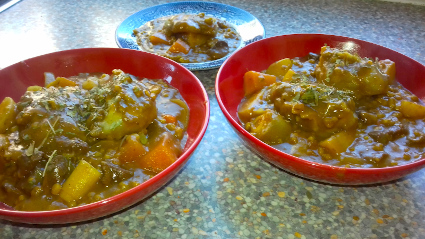
Mung Bean and Ox Heart Casserole

Mung Bean and Ox Heart Casserole

Ox Heart is really not a cut of meat we would generally even think about. But in yellow sticker land this pack was 33p and there’s nothing that we’ve not been able to make a good meal from with a bit of planning and time. Although it is spring now this Casserole would make a very tasty ‘Winter Warmer’ and would easily feed a family of four for less than £2 – Which even by our standards is pretty good going…...

Ingredients:-

425g Chopped Ox Heart
Plain Flour
Salt & Pepper
Onion Salt
Cayenne Pepper
Turmeric
Basil
Coriander
Mustard Powder
100g Mung Beans
½ a Leak, sliced
1 Carrot, cut into batons
2 Potatoes, quartered with the skins on
1/3 of a small Swede, pealed and cubed
2 Shallots, pealed and halved
1 Stock cube
A Squirt of Tomato Puree
A Slug of Tomato Ketchup
2 Bay Leaves
Oil to fry

Method:-

(1) Soak the Mung Beans in salted water for at least 3 hours.
(2) Mix the Salt & Pepper, Onion Salt, Cayenne Pepper, Turmeric, Basil, Coriander, Mustard Powder – into the Flour in a large bowl.
(3) Coat the Ox Heart in the seasoned flour and fry to brown slightly on all sides. Set aside.
(4) Dissolve the Stock in 1l of water.
(5) Drain and rinse the Muck Beans.
(6) Layer the Mung Beans, Vegetables and Heart in a casserole or slow cooker.
(7) Add the stock so that everything is submerged.
(8) Cook on a moderate heat for a good 4 hours in the oven or a slow cooker, stirring and adding water occasionally if it gets too thick.

Serve with Sage and Onion dumplings for a good “Hearty” meal (Sorry pun intended!). For a total cost of less than £2 we have enough Casserole for at least four good sized portions.


On Facebook

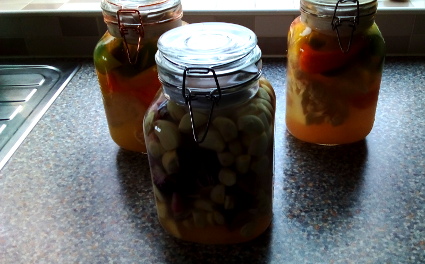
Lacto - Fermented Garlic/Red Onion & Cauliflower/Mixed Peppers

We ferment veg on a rolling basis these days. A little of the brine from a previous batch works as a bacteria ‘Prime’ and gets the fermentation off to a flying start. But pretty much anything with any natural sugars in it will work if you have a clip top jar, some Salt and Water.

The ingredients veg wise are really arbitrary now. We had a catering bag of Garlic which was destined for composting as it had done the rounds through the local Food Banks and was sprouting. So I added a couple of quartered Red Onions to fill the jar. We did Cauliflower and fresh Chilli a while ago which Sue really liked. So the Cauliflower and mixed Peppers is a take on that, but perhaps not with as much heat? We shall see…..

The basic ‘Good for all’ brine is a 2% concentration. So 2 to 3 heaped Table Spoons of Salt per Litre of water is a good starting concentration. I use Himalayan Salt as it doesn’t have the anti-caking agents added which can sometimes inhibit the fermentation.

The only rule of thumb with one of the oldest food preservation techniques is just to make sure that your brine is at room temperature i.e. not too hot, before adding the veg. If you boil the brine to dissolve the salt the heat will kill the bacteria which you need and the whole gig will just go bad!!! Really bad! That’s the worst that can possibly happen but  you’ll know by sight and smell.

The best that can happen is that it will ferment and you’ll end up with pickles which make shop bought ones seem very bland.

Also the Lactobacillus Bacteria are supposedly very good for your ‘Gut Health’ That’s not why we make these pickles though. We just like them and it’s a great way to get the best out of veg which was perhaps well beyond it’s best when we got it…...

Social Links

Translate

English French German Italian Portuguese Russian Spanish